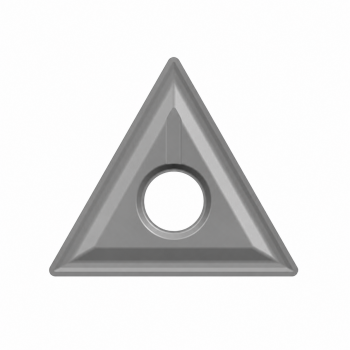
How to Select a Carbide Insert Grade for Steel
Selecting a carbide insert grade for steel turning is a balance between wear resistance, edge toughness and process stability. The hardest or most wear-resistant grade is not automatically the best choice. A grade that performs well in stable continuous cutting may chip in an interrupted operation, while a very tough grade may wear too rapidly in a long, thermally demanding cut.
A reliable selection therefore starts with the workpiece and machining condition—not with the grade number alone.
What Is a Carbide Insert Grade?
A coated carbide grade combines a cemented-carbide substrate with a defined coating system. Its actual cutting behavior is also influenced by the insert geometry, chipbreaker and cutting-edge preparation.
| Element | Primary role |
|---|---|
| Carbide substrate | Provides the basic balance between hardness, deformation resistance and toughness. |
| Coating system | Protects the substrate against flank wear, crater wear, heat and chemical interaction. |
| Edge preparation | Influences edge strength, sharpness and resistance to chipping. |
| Chipbreaker | Controls chip formation, cutting force and the usable feed/depth-of-cut range. |
| Cutting data | Determines the actual thermal and mechanical load on the cutting edge. |
For this reason, the grade and chipbreaker should always be selected as one complete application combination.
Step 1: Confirm That the Material Belongs to ISO P
The ISO P group covers many commonly machined steels, but steel is still a broad description. Confirm the material designation, carbon and alloy content, hardness, heat-treatment condition, product form and the presence of scale, welds or hardened surface layers.
Stainless steels are normally classified in ISO M, while hardened steels may move into ISO H depending on hardness and machining strategy. A grade selected for ordinary ISO P steel should not automatically be applied to those groups.
Step 2: Define the Operation
| Operation | Typical priority |
|---|---|
| Finishing | Low cutting force, dimensional accuracy, surface quality and reliable chip control. |
| Medium machining | Balance of productivity, wear resistance and process security. |
| Roughing | Edge strength, fracture resistance and reliable material removal. |
The operation determines both the required chipbreaker and the load placed on the grade. A finishing chipbreaker used outside its intended feed and depth-of-cut range may fail even if the carbide grade itself is suitable.
Step 3: Evaluate Cutting Stability
Evaluate the whole system: continuous or interrupted cutting, workpiece and fixture rigidity, toolholder condition, overhang, allowance variation, entry and exit impact, scale, keyways, holes and coolant stability.
A stable continuous cut generally allows a more wear-resistant selection. Increasing interruption, vibration or impact shifts the requirement toward a tougher grade and a stronger cutting edge.
Step 4: Balance Wear Resistance and Toughness
Long time in cut
Higher wear resistance
General steel turning
JE8025P starting position
Impact and roughing
Higher toughness
| Machining condition | Main requirement | Selection direction |
|---|---|---|
| Stable, continuous and long time in cut | Heat and wear resistance | Move toward the wear-resistant side. |
| General medium steel turning | Balanced performance | Start with a general-purpose steel grade. |
| Variable allowance or light interruption | Wear resistance plus edge security | Start general; move tougher if chipping occurs. |
| Roughing or strong interruption | Fracture resistance | Move toward a tougher grade. |
| Weak setup or vibration tendency | Edge security | Improve stability first, then consider a tougher combination. |
Tougher grades are generally more tolerant of interrupted cuts and vibration, but excessive toughness can come with faster flank wear, crater wear or plastic deformation. Grade selection is therefore a trade-off rather than a simple harder-is-better decision.
JetEdge Starting Grades for Steel Turning
| JetEdge grade | Coating route | Recommended starting position |
|---|---|---|
| JE8025P | CVD | Medium machining and general steel turning under stable to moderately interrupted conditions. |
| JE8035P | CVD | Roughing, interrupted cutting and demanding conditions requiring greater edge security. |
Start with JE8025P for general medium machining. Move to JE8035P when repeated chipping, impact or interruption is the dominant problem. If wear is gradual but too rapid in a stable cut, review cutting speed, chipbreaker, coolant delivery and the need for a more wear-resistant application solution.
Important: JetEdge grade numbers are internal application designations. They should not be compared number-for-number with grade codes from another manufacturer.
Step 5: Use the Wear Pattern to Optimize the Grade
| Observed condition | Possible direction |
|---|---|
| Predictable flank or crater wear, but tool life is too short | Review cutting speed and heat load; consider a more wear-resistant solution. |
| Repeated micro-chipping | Check holder, overhang, runout and entry impact; consider a tougher grade or stronger edge. |
| Sudden fracture | Reduce mechanical overload, confirm insert seating and clamping, then move tougher if required. |
| Plastic deformation | Reduce thermal/mechanical load and select better deformation and heat resistance. |
| Poor chip control with little edge damage | Adjust chipbreaker, feed and depth of cut before changing the grade. |
| Built-up edge | Review cutting speed, edge sharpness, material condition and coolant/lubrication. |
| Notch wear at the depth-of-cut line | Check the work-hardened surface, scale, coolant and whether depth of cut can be varied. |
A grade change cannot compensate for a loose toolholder, excessive overhang, unstable workholding or a chipbreaker operating outside its intended range.
Step 6: Validate Under Controlled Conditions
Compare candidate grades while keeping the workpiece batch, insert shape and chipbreaker, holder, overhang, cutting data, coolant and entry/exit conditions unchanged. Record parts or cutting time per edge, wear pattern, chip form, dimensional change, surface finish and cycle time.
ISO 3685 establishes a controlled framework for tool-life testing in single-point turning. In production, a simplified but disciplined A/B test is more reliable than changing the grade, geometry and cutting data simultaneously.
Practical Selection Checklist
- Workpiece material designation and hardness.
- External, internal or face-turning operation.
- Finishing, medium or roughing requirement.
- Continuous or interrupted cutting condition.
- Current insert and toolholder designation.
- Cutting speed, feed and depth of cut.
- Coolant condition.
- Current wear or failure mode.
- Required improvement: tool life, surface quality, chip control or productivity.
Conclusion
The correct steel-turning grade is the grade that provides predictable wear and sufficient process security in the real machining system. Begin with the workpiece, operation and stability, choose the chipbreaker and grade as a combination, and optimize using actual wear evidence.
For general steel turning, JE8025P is the current JetEdge core starting grade. For roughing and interrupted conditions that demand greater edge toughness, evaluate JE8035P.
Send JetEdge your workpiece material, hardness, insert designation, cutting condition and current machining problem for application review.
General selection guidance only. Final selection depends on the complete insert designation, workpiece material, hardness, toolholder, cutting condition and cutting parameters. Published cutting data for the selected JetEdge product takes precedence.
Technical References
- ISO 513:2012 — Classification and application of hard cutting materials for metal removal with defined cutting edges.
- ISO 3685:1993 — Tool-life testing with single-point turning tools.
- Seco Tools — How to Select the Right Turning Grades According to Materials and Solutions.
- Tungaloy — T9200 Series: CVD Grades for Steel Turning.
- Hernández González et al. — Selection of Machining Parameters Using a Correlative Study of Cutting Tool Wear in High-Speed Turning of AISI 1045 Steel.